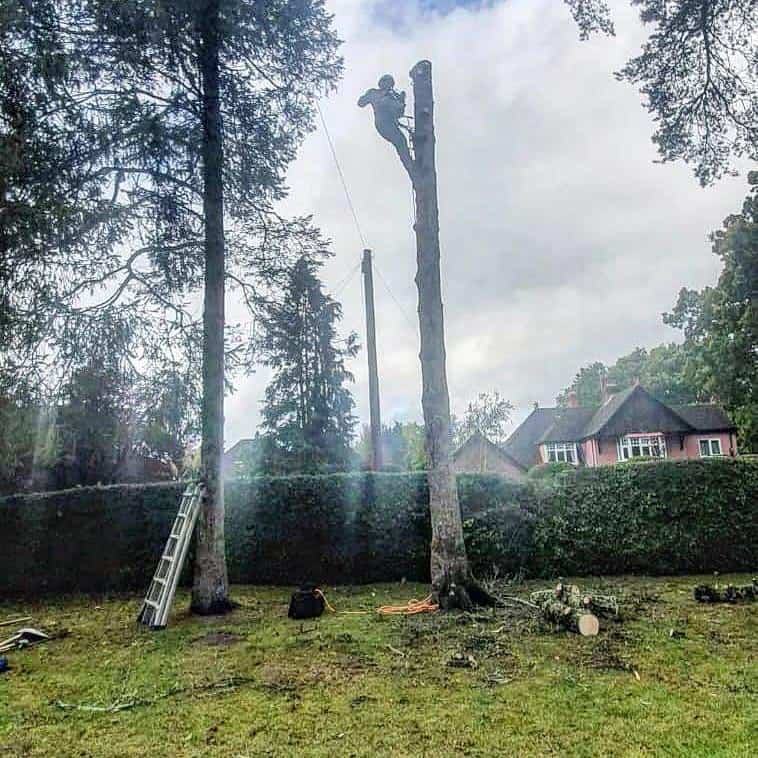
When a tree becomes too large, develops damaged branches or starts interfering with the way a garden is used, it can be difficult to know how much work is genuinely necessary. Tree felling may seem like the most straightforward answer, but many tree problems can be addressed through much less extensive work. In other situations, light pruning will not adequately address the underlying concern.
For property owners in Loughton, Essex, choosing between pruning, crown reduction and tree felling should begin with the condition and structure of the individual tree. The objective is not to carry out the greatest amount of work possible, but to identify the most appropriate intervention. Where a tree remains healthy and suitable for retention, targeted tree surgery can often resolve the problem while preserving established growth.
Does Your Tree Need Pruning, Crown Reduction or Complete Removal?
These three forms of tree work have very different purposes. Pruning generally targets specific branches or sections of growth. Crown reduction decreases the overall dimensions of the crown, while felling removes the complete tree.
The appropriate choice depends on why the tree has become a concern. Its health, structural condition, size, position, branch development and relationship with the surrounding garden all need to be considered before deciding how much work is appropriate.
Start by Identifying the Actual Problem
Before choosing a tree surgery method, it is important to define what needs to change.
Is one branch dead? Has the complete crown become too large? Are low branches restricting access? Has the tree started leaning? Is there widespread decline throughout the crown?
Each of these situations can require a different response.
Professional assessment prevents a relatively minor problem from automatically becoming a major tree surgery project.
One Problematic Branch May Only Need Pruning
Where a concern is confined to one branch, there may be no reason to alter the complete crown.
A damaged, dead or poorly positioned branch can often be dealt with selectively while retaining healthy surrounding growth.
This is one of the clearest examples of why tree felling should not automatically be considered whenever a mature tree develops a problem.
Targeted pruning addresses the specific defect while preserving the established tree wherever appropriate.
Dead Branches Do Not Automatically Mean the Tree Is Dying
Deadwood can occur within otherwise healthy trees.
One section of the crown may die while neighbouring branches continue producing healthy growth.
In these circumstances, selective deadwood removal may be appropriate.
Professional assessment can distinguish localised branch death from more widespread decline, helping ensure that a tree containing manageable deadwood is not unnecessarily treated as though the entire tree has failed.
Broken Branches Can Often Be Managed Locally
A substantial broken branch can make a tree look severely damaged.
However, the significance depends on where the failure occurred and how the remaining structure has been affected.
If the damage is confined to one limb and the rest of the tree remains suitable, professional pruning may be enough to deal with the affected section.
The remaining branch union should also be assessed to ensure that the problem is genuinely localised.
Hanging Branches Usually Require Targeted Attention
Branches can sometimes break but remain suspended within the crown.
These partially detached sections may be supported by neighbouring branches and can be difficult to assess accurately from the ground.
Removing the hanging material does not necessarily require extensive work throughout the tree.
Where the surrounding crown remains healthy, the intervention can often focus on the damaged branch and any directly affected growth.
Low Branches Can Be Managed Without Reducing the Whole Crown
As trees mature, lower branches can begin interfering with paths, driveways or frequently used parts of the garden.
If the tree’s overall size is otherwise suitable, targeted pruning may provide the necessary clearance.
The amount of branch removal should be carefully considered.
Removing numerous large lower limbs can significantly alter a mature tree, so the work should be proportionate to the actual clearance problem.
Overextended Individual Branches May Benefit From Selective Reduction
Sometimes the complete tree is not too large, but one or two branches extend considerably beyond the rest of the crown.
These branches may dominate a particular part of the garden or create an uneven appearance.
Where appropriate, selective branch reduction can shorten the relevant growth without reducing every part of the tree.
This can provide a much more focused solution than carrying out unnecessary work throughout the crown.
Pruning Is Most Useful When the Problem Is Specific
Pruning is generally most appropriate when there is a clearly identifiable section requiring attention.
This might include:
- individual dead branches;
- damaged or broken limbs;
- low growth restricting clearance;
- isolated overextended branches;
- hanging or partially detached material;
- particular areas of unsuitable growth.
The objective is to address these sections while retaining healthy branches that do not require intervention.
What If the Whole Tree Has Become Too Large?
A different approach may be needed when the concern relates to the overall dimensions of the crown rather than individual branches.
A mature tree can gradually become much taller or wider than it once was.
Its canopy may dominate the garden, extend across a substantial area or feel increasingly out of proportion with the available space.
Where the tree remains suitable for retention, crown reduction may provide an alternative to complete removal.
Crown Reduction Manages Overall Dimensions
Crown reduction involves selectively shortening branches throughout the outer crown.
The aim is to reduce height, spread or overall dimensions while maintaining an appropriate natural structure.
This is more comprehensive than dealing with one or two branches, but considerably less extensive than removing the tree.
The amount of reduction should be determined by the individual tree rather than simply cutting it back to an arbitrary size.
Crown Reduction Should Have a Clear Objective
A mature tree should not be heavily reduced simply because it has become large.
Large dimensions are natural for many established trees.
Crown reduction is most useful where there is a clear reason for managing the overall size or distribution of growth.
Professional assessment can determine whether reduction is appropriate and what level of work the tree can reasonably accommodate.
An Oversized Crown Does Not Automatically Mean Felling
A tree can become inconveniently large while remaining healthy and structurally suitable.
This is an important distinction.
If the main concern is simply the amount of space occupied by the crown, reducing its dimensions may provide a more proportionate solution than removing the complete tree.
The feasibility of this approach depends on the species, condition and existing structure of the tree.
An Unbalanced Crown May Need Selective Management
Not all trees grow evenly.
One side of the crown may become considerably more developed because of available light, surrounding space or previous pruning.
Where this creates an unsuitable structure, selective pruning or crown management may help improve the distribution of growth.
It is not always necessary to reduce the complete crown, making professional assessment useful when deciding between targeted pruning and broader reduction.
Dense Growth Does Not Necessarily Require Crown Reduction
A tree can have a dense crown without being excessively large.
Where branch density is the primary concern, reducing the overall dimensions may not necessarily address the issue appropriately.
Different pruning techniques can target specific parts of the crown depending on the tree and the objective of the work.
This illustrates why selecting the tree surgery method should come after identifying the problem rather than before it.
Excessive Shade Can Require a Measured Approach
A mature tree can cast considerable shade across a garden.
It can be tempting to assume that substantial crown removal is the quickest solution.
However, the amount and position of suitable pruning need to be considered carefully.
Depending on the tree, targeted crown management may help improve the relationship between the tree and surrounding space without unnecessarily removing large quantities of healthy growth.
A Tree Blocking Useful Garden Space May Still Be Manageable
As trees mature, branches can gradually occupy areas that were previously open.
This can affect paths, seating areas and other parts of the garden.
The appropriate response depends on whether the issue involves a few branches or the complete crown.
Targeted pruning may improve local clearance, while crown reduction may be more suitable where overall dimensions have become the main concern.
Tree Felling Is a Fundamentally Different Decision
Tree felling removes the complete tree rather than modifying its crown.
For that reason, it should be considered differently from ordinary pruning.
Where a tree remains healthy, structurally suitable and capable of being managed through proportionate tree surgery, complete removal may not be necessary.
Felling becomes more relevant when the problem affects the tree as a whole rather than a manageable section of growth.
A Completely Dead Tree Requires Different Consideration
There is an important difference between a healthy tree containing dead branches and a completely dead tree.
Localised deadwood can often be removed selectively.
A completely dead tree cannot recover or produce new healthy growth. Its structural condition will continue changing as the remaining wood deteriorates.
Professional assessment can confirm whether a tree is genuinely dead and whether felling is the appropriate response.
Widespread Decline Can Change the Decision
A tree with sparse growth in one branch may have a localised problem.
A tree showing extensive dieback throughout most of the crown presents a different situation.
Where decline is widespread, assessment should consider the condition of the trunk, roots and remaining living growth rather than concentrating only on individual branches.
The extent of the problem helps determine whether pruning remains worthwhile or whether a more substantial approach needs consideration.
Significant Trunk Problems Require Broader Assessment
Pruning can manage branch-related problems, but it cannot correct every structural issue within the main trunk.
Large cracks, substantial deterioration or other significant changes within the trunk need to be considered in relation to the complete tree.
This does not mean that every cavity or defect automatically requires felling.
It means that reducing a few branches should not be assumed to resolve a problem originating within the tree’s primary supporting structure.
Root Instability Cannot Simply Be Pruned Away
The root system provides the tree with essential anchorage.
Where a tree has developed recent movement at its base, a changing lean or visible ground disturbance, the concern may involve overall stability.
Removing branches or reducing the crown does not automatically resolve a significantly compromised root system.
Professional assessment is particularly important in these circumstances because the underlying issue affects the complete tree.
A Leaning Tree Does Not Automatically Need Felling
Not every leaning tree is unstable.
Some trees develop at an angle while young and remain established in that position for many years.
The more important consideration is whether the lean is longstanding or has recently changed.
A stable, established lean can present a very different situation from a tree that is actively moving. Felling should therefore not be recommended simply because the trunk is not vertical.
Recent Movement Is More Significant Than Appearance Alone
If a previously upright tree begins leaning noticeably, further investigation is appropriate.
Raised soil, cracks around the base or visible changes in the root area can provide additional information.
In these circumstances, the question is no longer simply how the crown should be pruned.
The complete stability of the tree needs to be understood before deciding whether retention remains appropriate.
Previous Branch Failure Does Not Automatically Mean Removal
A tree that has lost a substantial limb can look dramatically different afterwards.
However, one failure may have resulted from a defect confined to that particular branch.
Professional assessment can examine the remaining crown and branch unions to determine whether similar problems exist elsewhere.
Where the rest of the structure remains suitable, corrective pruning may be sufficient.
Several Structural Problems Together Can Change the Picture
One minor defect can often be managed locally.
Multiple significant problems occurring together deserve broader consideration.
For example, widespread crown decline combined with trunk deterioration and recent movement at the base presents a different situation from one broken branch in an otherwise healthy tree.
The pattern of problems is therefore more informative than any single symptom.
Previous Pruning Can Influence What Work Is Needed Now
Trees respond to previous tree surgery.
Earlier heavy cutting can result in dense regrowth or altered branch structures, while repeated selective management may have maintained a more controlled crown.
Understanding what has happened previously can help determine the appropriate next step.
A tree with strong regrowth may require careful pruning rather than simply repeating an excessively severe cut.
Repeated Heavy Pruning May Not Be the Best Long-Term Approach
If a tree continually requires substantial cutting to fit within the available space, it may be useful to reassess the management strategy.
That does not automatically mean felling is necessary.
A professionally planned reduction followed by appropriate future maintenance may provide a more consistent approach.
The objective is to avoid carrying out unnecessarily severe work every time the crown regrows.
Sometimes No Tree Surgery Is Needed
Professional assessment does not necessarily lead to pruning, crown reduction or felling.
A tree may appear large or unusual while remaining entirely suitable for its surroundings.
A longstanding lean, naturally broad crown or large healthy branch can attract concern without representing a defect.
Where intervention has no clear purpose, leaving the tree alone may be the most appropriate decision.
How to Recognise When Pruning May Be Enough
Pruning may be appropriate where:
- the problem involves one or several individual branches;
- localised deadwood is present;
- a branch has broken or become damaged;
- low growth is restricting clearance;
- isolated branches are overextended;
- most of the crown remains appropriately sized;
- the tree remains healthy and structurally suitable overall.
This allows the work to remain focused on the actual area of concern.
When Crown Reduction May Be More Appropriate
Crown reduction may deserve consideration where:
- the complete crown has become excessively large for the available space;
- height and spread both require management;
- several outer branches need coordinated reduction;
- the tree remains suitable for retention;
- targeted pruning alone would not adequately manage overall dimensions.
The amount of reduction should always reflect the individual tree and its ability to respond appropriately.
When Felling May Need to Be Considered
Felling becomes more relevant where problems cannot reasonably be resolved through pruning or crown management.
Examples can include complete tree death, significant structural deterioration affecting the tree as a whole or substantial instability.
The decision should be based on actual condition rather than inconvenience alone.
A mature tree that simply requires management is very different from one whose fundamental structure has seriously deteriorated.
Avoid Choosing the Most Extensive Option First
When a tree becomes inconvenient, complete removal can initially seem simpler than planning ongoing management.
However, established trees can often be retained successfully through proportionate tree surgery.
Starting with the least extensive appropriate intervention helps preserve healthy growth where practical.
If professional assessment shows that pruning will not adequately resolve the problem, crown reduction or felling can then be considered based on clear reasons.
The Right Amount of Tree Work Is Condition-Led
There is no standard amount of pruning that suits every tree.
Two trees of similar size can require completely different approaches depending on their species, structure, health and surroundings.
One may only need a damaged branch removed. Another may benefit from crown reduction, while a tree with extensive deterioration may require more substantial intervention.
Tree surgery should therefore be based on what the individual tree genuinely needs.
Why Professional Tree Assessment Matters
Choosing between pruning, crown reduction and felling requires an understanding of the complete tree.
The crown, individual branches, trunk, visible root area, growth pattern and surrounding space all provide useful information.
Professional assessment helps identify whether the concern is localised, relates to overall crown size or affects the fundamental condition of the tree.
This provides a more proportionate basis for deciding how much work is necessary.
Professional Tree Surgery in Loughton, Essex
At Loughton Tree Surgeons, we understand that property owners do not always know whether a troublesome tree needs a small amount of pruning, substantial crown management or complete removal.
Our approach is to consider the actual condition and requirements of the tree before determining the appropriate level of work. Where healthy growth can reasonably be retained, targeted tree surgery can often provide a suitable solution without unnecessary intervention.
For trees in Loughton, Essex, professional assessment can help identify the most appropriate balance between managing the problem and preserving a suitable established tree.
Conclusion
Pruning, crown reduction and tree felling solve very different problems. Pruning is often appropriate for individual dead, damaged, low or overextended branches. Crown reduction can help where the overall dimensions of a healthy tree have become unsuitable, while felling is generally a more significant consideration where problems affect the viability or structural condition of the complete tree.
The amount of work should therefore be determined by the cause of the problem rather than simply the size of the tree. A mature tree that has become inconvenient does not automatically need removing, just as light pruning may not be sufficient where significant structural deterioration is present.
A professional assessment can distinguish between these situations and identify the least extensive appropriate solution.
If you are unsure whether a tree at your property in Loughton, Essex needs pruning, crown reduction or more substantial work, contact Loughton Tree Surgeons. We can assess its condition and recommend an appropriate tree surgery approach based on what the tree genuinely requires.
Call us on: 020 4572 0898
Click here to find out more about Loughton Tree Surgeons
Click here to complete our contact form and see how we can help with your tree care needs.